
Metro Line: Green line
The Namma Metro Green Line in Bengaluru, Karnataka, India, was developed concurrently with the Purple Line during the first phase of the metro rail system’s construction. Covering a distance of 30.5 kilometers (19.0 miles), this crucial transit route connects Nagasandra in the northwest to Silk Institute in the south, serving as a vital transportation link for Bengaluru residents.
Line: Green line All Metro Stations
Loading
Line: Green line Quick Info
- Status: Opperational
- Operational Stations: 29
- Under Construction Stations: 3
- Line Length: 30.69 km (19.07 mi)
- Tracks Number: 2
- Operating Speed: 40 km/h (25 mph)
- Daily Riderships:62.3 million as per 2019
Gren Line Terminals
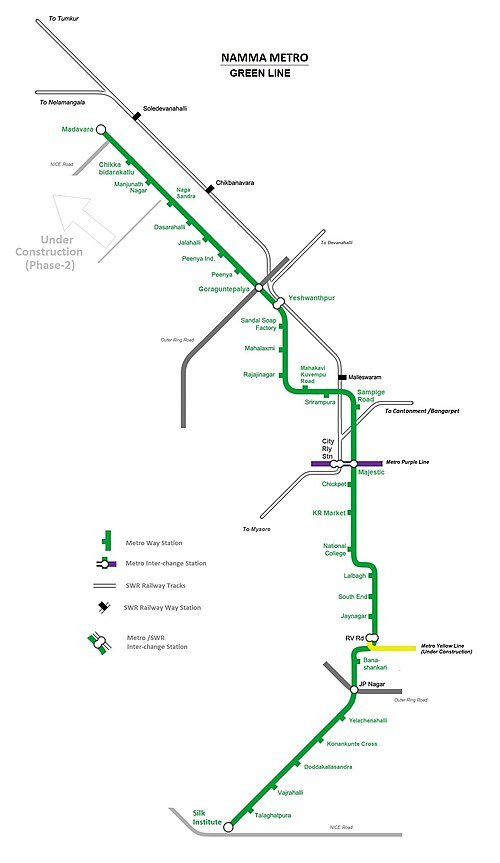
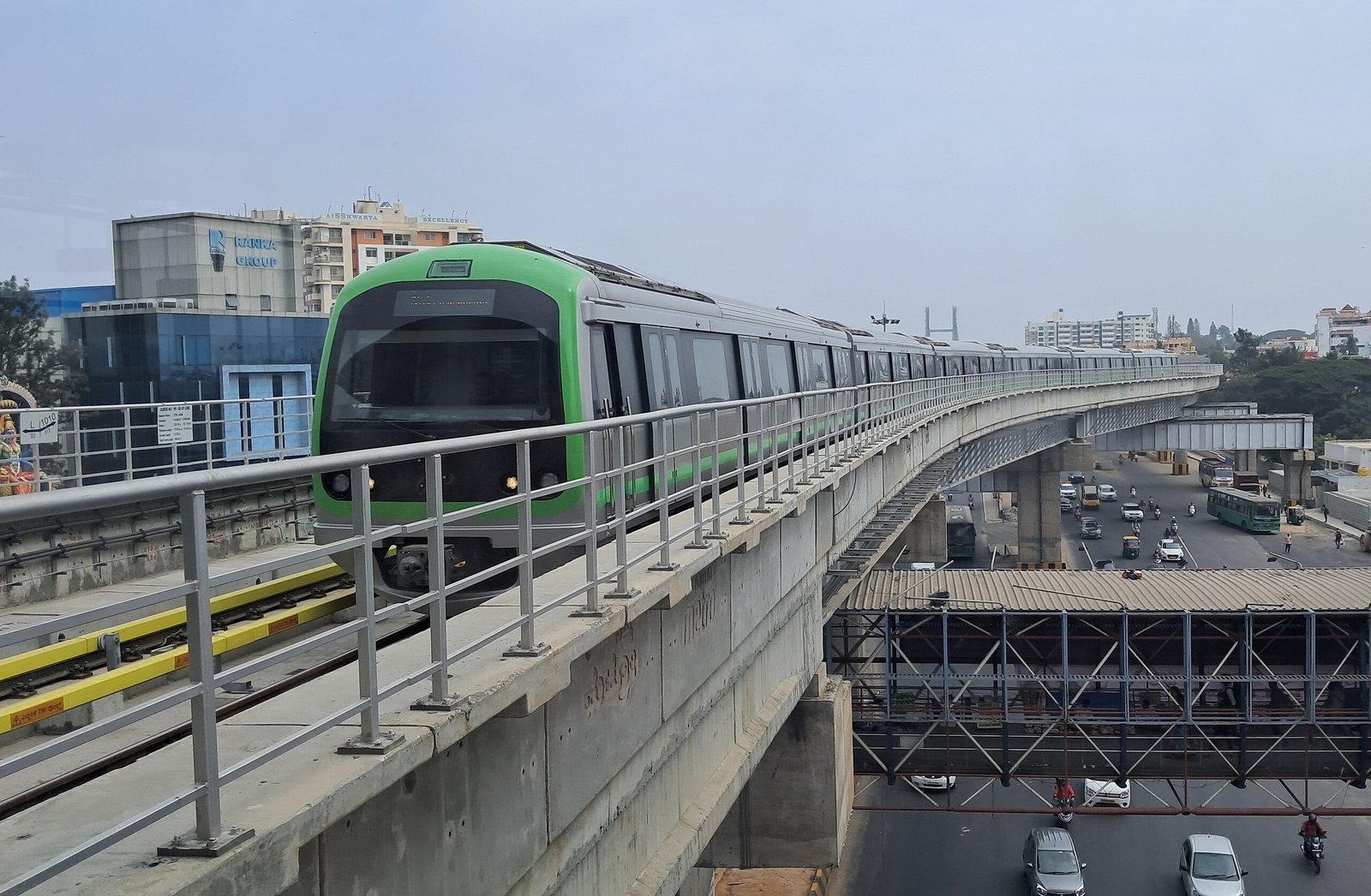
The Namma Metro Green Line is a major north-south corridor in Bengaluru, connecting Nagasandra in the north to Silk Institute in the south.
Spanning approximately 30.5 km, the line serves both residential neighborhoods and industrial hubs, making it a critical part of the city’s transit system.
Development Overview
The Green Line was developed during Phase I and Phase II:
- Underground sections constructed using TBM technology
- Elevated sections extended toward Silk Institute and Madavara
Interchange Connectivity
Important interchange stations include:
- Nadaprabhu Kempegowda (Majestic) → Interchange with Purple Line
- Rashtreeya Vidyalaya Road → Interchange with Yellow Line
Key Areas Covered
The Green Line connects:
- Nagasandra
- Yeshwanthpur
- Majestic
- Basavanagudi
- Jayanagar
- Banashankari
- Kanakapura Road
- Silk Institute
Connectivity Benefits
The line connects:
- Peenya Industrial Area
- Yeshwanthpur industrial belt
- Central Bengaluru
- South residential areas
Timings & Frequency
- Operating Hours: 5:00 AM to 11:00 PM
- Frequency varies based on peak/non-peak
- Travel time: ~40–45 minutes
Train Capacity
- 6-coach trains
- Capacity ~2000 passengers per train
Nearby Attractions
- ISKCON Temple (Yeshwanthpur)
- Lalbagh Botanical Garden
- Basavanagudi
- Banashankari Temple
Role in Network
The Green Line:
- connects north and south efficiently
- acts as a feeder to Purple Line
- integrates with upcoming Yellow Line
FAQ's
What are the key areas connected by Bengaluru's Metro Green Line?
Bengaluru's Metro Green Line serves as a vital link connecting Nagasandra in the northwest to Silk Institute in the south. It facilitates seamless connectivity between industrial centers like Peenya and Yeshwanthpur in the north, the central hub of Majestic, and southern residential areas including Basavanagudi, Jayanagar, Banshankari, and Kanakapura Road. The Majestic station acts as a crucial interchange point between the Green and Purple Lines, enhancing overall metro network connectivity.
How was the construction of Bengaluru's Metro Green Line executed during Phase I?
Phase I construction involved the commencement of Reach 3 and 3A in 2009–10, with a project cost of ₹2,100 crore. Notable elements include the deployment of Tunnel Boring Machines (TBMs) named Kaveri, Krishna, and Godavari for the underground section. The first trial run occurred on 8 August 2013, marking a significant milestone. Despite challenges, the inaugural section of the Green Line became operational on 1 March 2014.
What extensions are introduced in Phase II of Bengaluru's Metro Green Line?
Phase II introduces two significant extensions: Reach 4B from Yelachenahalli to Silk Institute and Reach 3C from Nagasandra to Madavara. Reach 4B was inaugurated on 14 January 2021, marking the first operational section of Phase II. Reach 3C's construction, awarded to Simplex Infrastructure Limited, is anticipated to be completed by June–August 2022, contributing to the continued expansion of the Green Line.
How long is Bengaluru's Metro Green Line?
Bengaluru's Metro Green Line spans a distance of 30.5 kilometers, linking Nagasandra in the northwest to Silk Institute in the south. With 26 elevated stations and 3 underground stations, it forms a crucial transportation artery in the city.
When did the first section of Bengaluru's Metro Green Line become operational?
The first section of Bengaluru's Metro Green Line became operational on 1 March 2014. BMRCL Managing Director Pradeep Singh Kharola noted that about 25,000 passengers traveled on the line on the opening day, marking a successful initiation of service.